Laser and IPL Patch-Test Records: A Practical Guide for Technicians
Hair Removal5 min read

Laser and IPL Patch-Test Records: A Practical Guide for Technicians

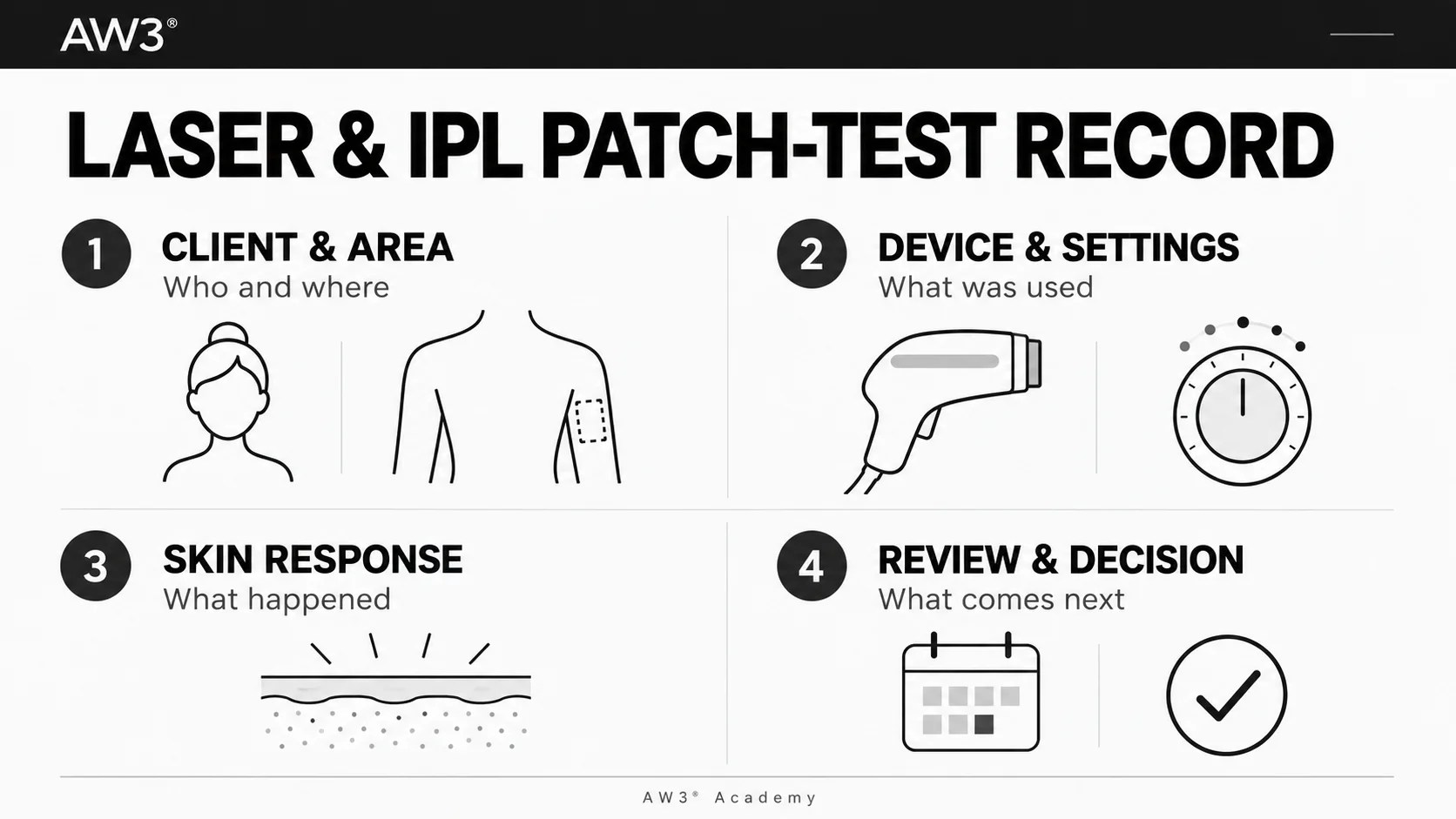
A laser or IPL patch-test record should show who was tested, where the test took place, which device and settings were used, how the skin responded and what happened at the follow-up. It should also explain the practitioner’s decision about the planned treatment. A patch test helps a trained practitioner assess the skin’s response to

Published ·Updated ·By Dr Frankie

A laser or IPL patch-test record should show who was tested, where the test took place, which device and settings were used, how the skin responded and what happened at the follow-up. It should also explain the practitioner’s decision about the planned treatment.

A patch test helps a trained practitioner assess the skin’s response to a proposed treatment. Clear notes make that response easier to review, especially if a different practitioner sees the client later. This guide explains what UK laser and IPL clinics should record.

What is a laser or IPL patch test?

A patch test applies a small number of test pulses to an appropriate area. The practitioner observes the immediate response and checks for any delayed reaction at the review point set by the relevant protocol. The findings help them decide whether to change the proposed treatment plan.

A patch test is only one part of the assessment. The practitioner still needs to review the client’s health, medicines, recent sun exposure, skin condition and other factors that may affect suitability.
patch test infographic

What should a patch-test record include?

Write enough detail for another trained practitioner to understand what was tested, what happened and how the decision was made. Use the terms shown on the device and record the values actually used, rather than copying an earlier client’s settings.

Client and test location

Identify the client by name and clinic reference, and record the test date, time and practitioner. State the proposed treatment and the exact test site. “Inside of the lower right leg” is more useful than “leg”, particularly if several areas may be treated.

Skin assessment

Note the skin type and current appearance of the test area, including any tan, irritation or damage. Record recent sun or sunbed exposure, fake tan, relevant health or medicine changes and any tattoos, moles or other areas that must be avoided. For hair removal, add the hair colour, thickness and density. If the assessment raises a concern, explain why the test was delayed or why the plan changed.

Device and test settings

Record the manufacturer, model and an identifier such as the machine’s serial number. Name the handpiece, wavelength or IPL filter, treatment mode and spot size where these apply. Note the fluence or energy, pulse duration, repetition rate, cooling, number of pulses and technique as relevant to the device. If a preset or automatic mode was used, record that too. A note that says only “laser” or “IPL” is too vague to reconstruct the test.

How should the skin response be recorded?

Avoid vague notes such as “fine”, “normal” or “no problem”.

Describe what you actually see and what the client reports.

Immediate Response

Record:

  • Redness
  • Swelling around the follicles
  • Heat
  • Discomfort
  • Skin whitening
  • Blistering
  • Unexpected colour change
  • Any unusual reaction

Also record the client’s comfort level. A simple scale from 0 to 10 can help, but add written notes when needed.

For example:

Mild redness and slight warmth. Client reported discomfort of 2 out of 10. No blistering or unexpected pigment change observed.

Delayed Response

Some reactions may appear after the client leaves the clinic.

At the agreed review time, record:

  • Whether redness has settled
  • Any swelling
  • Itching or tenderness
  • Blistering
  • Crusting
  • Pigment change
  • Pain
  • Other concerns
  • Photographs supplied by the client
  • Advice given by the clinic

If the client reports a reaction, record the date, time and method of contact.

How long should you wait after a patch test?

There is no single waiting period that fits every device, treatment and client. Check the manufacturer’s instructions, the clinic’s approved procedure, insurer conditions and any applicable local requirements. Advice from the clinic’s Laser Protection Adviser may also be relevant. Record the required interval and the planned review time. Do not carry out the full treatment until the required interval has passed and the response has been assessed.

When should a patch test be repeated?

Review the need for another test if the client’s health, medicines, skin colour or sun exposure has changed, or if there has been a long gap since treatment. A new treatment area, device, handpiece, wavelength or significant change in settings may also require a fresh assessment. An unexpected earlier reaction is another reason to pause and review the plan.

Whether to repeat the test depends on the device protocol, clinic policy, insurer conditions and the practitioner’s assessment. Record the reason for the decision and, if you test again, note how the new test differs from the earlier one.

Simple Patch-Test Record Form

Clinics can use the following structure as a starting point.

Client Details

  • Client name:
  • Client reference:
  • Date of birth:
  • Treatment:
  • Treatment area:
  • Test location:
  • Practitioner:
  • Test date and time:

Assessment

  • Fitzpatrick skin type:
  • Current skin condition:
  • Hair colour:
  • Hair thickness:
  • Recent sun exposure:
  • Fake tan:
  • Medicines or health changes:
  • Areas to avoid:

Device and Settings

  • Manufacturer:
  • Machine model:
  • Serial number:
  • Handpiece:
  • Wavelength or IPL filter:
  • Spot size:
  • Fluence or energy:
  • Pulse duration:
  • Repetition rate:
  • Cooling:
  • Number of pulses:
  • Technique:

Immediate Response

  • Visible skin response:
  • Client comfort:
  • Unexpected reaction:
  • Photographs taken:
  • Aftercare given:

Delayed Response

  • Review date and time:
  • Client feedback:
  • Visible response:
  • Photographs received:
  • Further advice given:

Decision

  • Suitable to proceed:
  • Proceed with adjusted settings:
  • Repeat test required:
  • Treatment postponed:
  • Treatment declined:
  • Reason:
  • Approved treatment settings:
  • Practitioner signature:
  • Date:

The form should be checked against the clinic’s machine protocol, insurer requirements and local rules before use.

Store the patch-test findings with the client’s consultation, relevant medical history, contraindication assessment, consent, treatment notes and aftercare advice. Keep any clinical photographs and follow-up messages with the same record so the reason for the treatment decision is clear. Give access only to authorised staff and follow the clinic’s data-handling procedures.

Common patch-test record mistakes

Avoid:

  • Recording only “patch test passed”
  • Leaving out the machine model
  • Failing to record the handpiece
  • Missing treatment settings
  • Using unclear test-area descriptions
  • Recording only the immediate response
  • Forgetting to note client feedback
  • Copying settings from a previous client
  • Failing to check for health or medicine changes
  • Using one patch-test protocol for every device

Each machine and treatment protocol may be different. Staff must use the instructions for the exact system being operated.

Train staff to test and document consistently

Practitioners need to know how to assess suitability, use the specific device, recognise skin responses and write a clear record. AW3® Academy’s laser hair removal training course covers consultation, assessment and aftercare for laser and IPL hair reduction. Clinics offering other IPL treatments can review the IPL training course and check that staff training matches the treatment and machine they use.

Related blogs

All insights
Hair Removal

Laser Machines Demo Checklist for UK Clinics

A laser machine demonstration should help you assess how the system works during a real treatment appointment. Consider handpiece comfort, cooling, cleaning and supplier support. You should not judge a machine only by its screen, power figures or sales presentation. Buying a professional laser machine is a major investment for a UK salon or clinic.

Read article
Business & Marketing Tips

The Profit Potential of Laser Hair Removal for Your Aesthetic Business in Australia

As an aesthetic business owner in Australia, you’re always looking for ways to increase your revenue and expand your offerings. Laser hair removal is a popular and profitable treatment that can attract new clients and increase your profits. In this blog, we’ll explore why laser hair removal is a profitable investment in Australia and provide

Read article
Business & Marketing Tips

The Profit Potential of IPL Hair Removal for Your Aesthetic Business in Australia

In the Australian aesthetic market, offering the latest and most effective treatments can set your business apart and boost your profits. Intense Pulsed Light (IPL) hair removal is a highly sought-after treatment due to its efficiency and minimal discomfort. In this blog, we’ll discuss the rising demand for IPL hair removal, its profit potential, and

Read article
Business & Marketing Tips

The Profit Potential of Laser Hair Removal for Your Aesthetic Business in the USA

As an aesthetic business owner in the USA, you’re always looking for ways to increase your revenue and expand your offerings. Laser hair removal is a popular and profitable treatment that can attract new clients and increase your profits. In this blog, we’ll explore why laser hair removal is a profitable investment in the USA

Read article
Business & Marketing Tips

The Profit Potential of IPL Hair Removal for Your Aesthetic Business in the UK

As an aesthetic business owner in the UK, staying competitive involves continuously offering services that meet the evolving needs of your clients. Intense Pulsed Light (IPL) hair removal is a treatment that has gained significant popularity due to its effectiveness and non-invasive nature. In this blog, we’ll explore the growing demand for IPL hair removal,

Read article
Business & Marketing Tips

The Profit Potential of IPL Hair Removal for Your Aesthetic Business in the USA

As an aesthetic business owner in the USA, it’s crucial to offer services that meet the demands of your clients and maximize your profitability. Intense Pulsed Light (IPL) hair removal is a popular and effective treatment that has gained traction due to its efficiency and comfort. In this blog, we’ll explore the increasing demand for

Read article
Hair Removal

IPL Hair Removal: A Non-Invasive Alternative to Traditional Methods

Unwanted hair can be a frustrating and time-consuming problem for many people. While traditional hair removal methods, such as shaving, waxing, and electrolysis, can be effective, they are often painful and time-consuming. Fortunately, Intense Pulsed Light (IPL) therapy provides a non-invasive alternative to traditional hair removal methods. In this blog, we’ll explore how IPL therapy

Read article
Business & Marketing Tips

The Profit Potential of Laser Hair Removal for Your Aesthetic Business in the UK

As an aesthetic business owner, it’s important to continually evaluate the services you offer to ensure that you’re meeting the needs of your clients and maximizing your profits. Laser hair removal is a popular and profitable treatment that can attract new clients and increase your revenue. In this blog, we’ll explore the growing demand for

Read article
AW3® Academy

Laser Hair Removal and Pigmentation: What You Need to Know

Laser hair removal is one of the most popular cosmetic treatments worldwide, offering a long-term solution to unwanted hair. However, if you’ve been wondering about the relationship between laser hair removal and pigmentation, you’re not alone. Many people are concerned about whether the procedure is suitable for their skin tone or whether it might cause

Read article
Case Studies & Testimonials

Transforming Lives and Careers: Lucy’s Experience w/ the AW3® Schnelle™ Ultra

From a career in law enforcement to running a thriving laser clinic, Lucy’s journey is a testament to the transformative power of pursuing your passion. As the owner of Laser Lab in Knottingley, West Yorkshire, Lucy shares her inspiring story about how switching to the beauty industry and investing in the AW3® Schnelle™ Ultra has

Read article
Case Studies & Testimonials

How Toni Transformed Be Bare Clinic w/ the AW3® Crystal Freeze® Diamond

In the competitive world of beauty and aesthetics, staying ahead with the latest technology can significantly impact your business. Toni Gascoyne, founder of Be Bare Clinic, is a shining example of how embracing advanced technology can elevate a business. Toni’s journey from traditional hairdressing to becoming a leader in laser hair removal highlights the transformative

Read article
AW3® Academy

Hirsutism & Laser Hair Removal

Hirsutism, characterized by excessive hair growth in areas where men typically grow hair, can be a challenging condition for many women. It often leads to emotional distress and social discomfort. Laser hair removal offers a long-term solution to manage and reduce unwanted hair, providing significant relief for those affected by this condition. What is Hirsutism?

Read article
AW3® Academy

Pseudofolliculitis Barbae & Laser Hair Removal

Pseudofolliculitis barbae, commonly known as razor bumps, is a condition where hair follicles become inflamed after shaving, leading to bumps and irritation. Laser hair removal can be an effective treatment to manage and reduce this condition. For professionals, with the right laser hair removal training, you can carry out the best treatment possible for the condtion

Read article
AW3® Academy

Hypertrichosis & Laser Hair Removal

Hypertrichosis is a condition characterized by excessive hair growth in areas where hair is not typically found. Laser hair removal can offer a long-term solution for managing and reducing excessive hair, improving both appearance and comfort. To give out a perfect long-term solution for this, one should take up a laser hair removal training course,

Read article
Hair Removal

Home IPL Hair Removal Devices: Are They Any Good?

In recent years, IPL (Intense Pulsed Light) and laser hair removal have gained popularity as effective methods for achieving smooth, hair-free skin. With advancements in technology, home IPL devices have become widely available, offering convenience and affordability. However, understanding the differences between home devices and professional salon equipment is crucial for making informed decisions about

Read article

Want to grow your clinic with AW3®?

Talk to our team. We'll recommend the right machine, support you through training, and be there every step of the way.